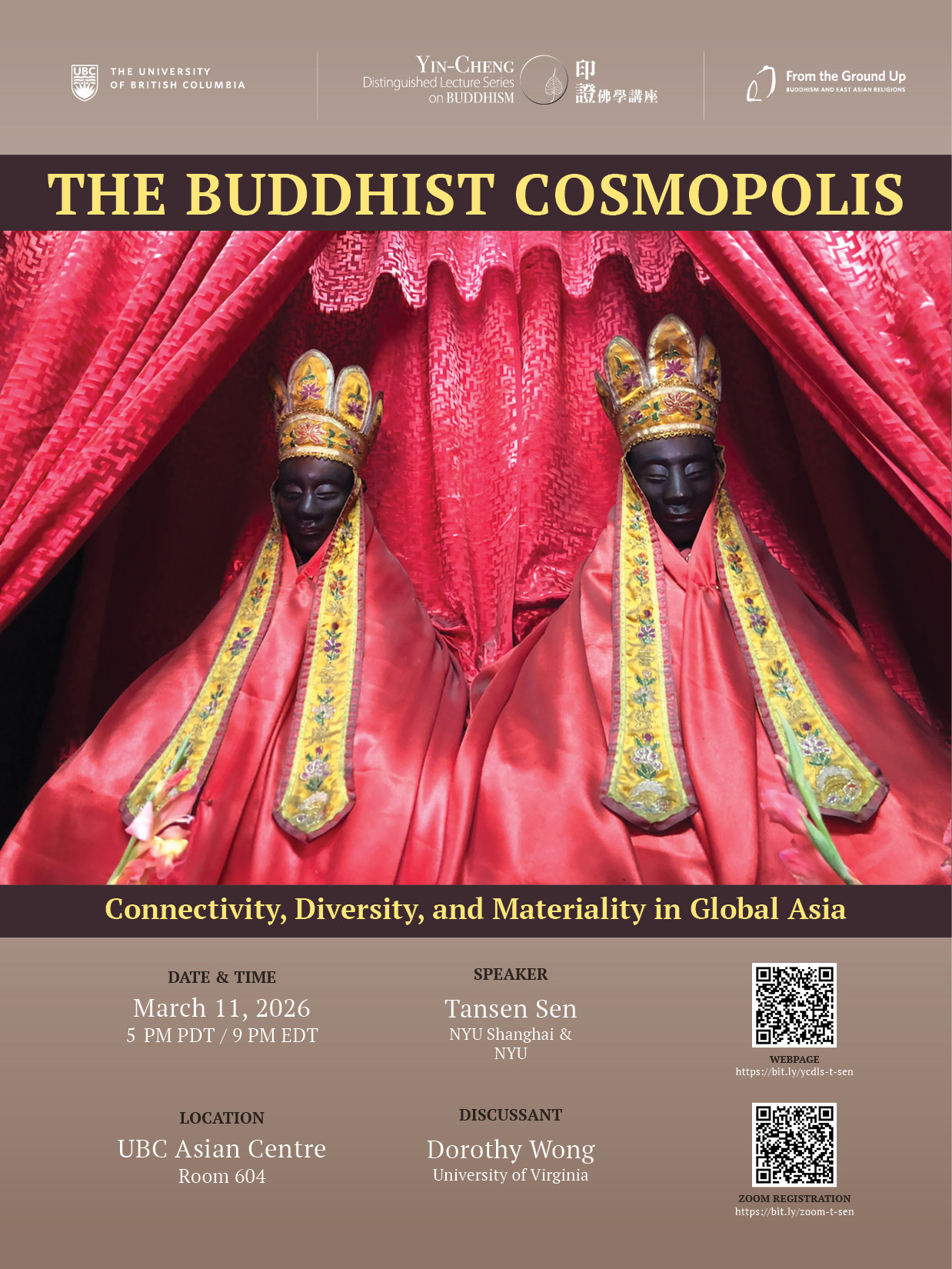
Time: March 11, 5:00 pm (Vancouver) | 8:00 pm (New York) | March 12, 8:00 am (Beijing/Taipei)
UBC Asian Centre, Room 604
The lecture will be presented in English, live-streamed via Zoom.
Abstract:
The circulation of Buddhist ideas, texts, artistic forms, and individuals gave rise to—and continues to sustain—a network of interconnected yet heterogeneous spaces across Asia and beyond, conceptualized here as a “Buddhist cosmopolis.” This presentation critically explicates the concept of the Buddhist cosmopolis and examines how its circulatory processes and diverse practices may be analyzed within the emerging analytical framework of Global Asia. It focuses in particular on the transmission of knowledge, the dissemination of visual culture, and the movements of missionaries and pilgrims, in order to illuminate both the spatial and ideological linkages that connected distant regions, as well as the distinctive local traditions that emerged across multiple sites. The presentation argues that approaching the Buddhist cosmopolis through the lenses of “convergence,” “divergence,” “entanglements,” and “translocality” yields critical insights into the dynamics of mobility and connectivity central to Global Asian studies. More broadly, it suggests that the concept of the Buddhist cosmopolis enhances our understanding of transregional interactions, the transformative capacities of Buddhist circulatory networks, and the complex spatial and temporal imaginaries generated by Buddhist mobilities over the past two millennia.
About the speaker: Tansen Sen (NYU Shanghai and NYU)

Tansen Sen is Professor of history and the Director of the Center for Global Asia at NYU Shanghai, and Associated Full Professor of History at New York University. Previously he was a faculty at the City University of New York and the founding head of the Nalanda Sriwijaya Center at the Institute of Southeast Asian Studies, Singapore. He is the author of Buddhism, Diplomacy, and Trade: The Realignment of Sino-Indian Relations, 600-1400 (2003; 2016) and India, China, and the World: A Connected History (2017; 2018). He has co-authored (with Victor H. Mair) Traditional China in Asian and World History (2012), edited Buddhism across Asia: Networks of Material, Cultural and Intellectual Exchange (2014), and co-edited (with Burkhard Schnepel) Travelling Pasts: The Politics of Cultural Heritage in the Indian Ocean World (2019), and (with Brian Tsui) Beyond Pan-Asianism: Connecting China and India, 1840s-1960s (2021). He is currently working on a book on the Ming admiral Zheng He, a collaborative project on China-India interactions during the 1950s, and co-editing (with Engseng Ho) the Cambridge History of the Indian Ocean, volume 1.
About the discussant: Dorothy Wong (University of Virginia)
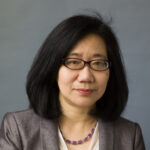 Dorothy C. Wong is currently Professor of Art History at the University of Virginia. Specializing in Buddhist art of China during the first millennium CE, her research addresses topics of art in relation to religion and society, and of the relationship between religious texts/doctrine and visual representations. In addition to many articles, she has published Chinese Steles: Pre-Buddhist and Buddhist Use of a Symbolic Form (2004; Chinese edition 2011), Hōryūji Reconsidered (editor and contributing author, 2008), China and Beyond in the Medieaval Period: Cultural Crossings and Inter-regional Connections (co-editor with Gustav Heldt, and contributing author, 2014), Buddhist Pilgrim-Monks as Agents of Cultural and Artistic Transmission: The International Buddhist Art Style in East Asia, ca. 645–770 (2018; Chinese edition forthcoming), Miraculous Images in Asian Traditions, vol. 50 of Ars Orientalis (editor and contributing author, 2020), and Dynamics of Interregional Exchange in East Asian Buddhist Art, 5th-13 Century (editor and contributing author, 2022). Currently she is working together with about two dozen international scholars researching the topic of “miraculous images” in global perspectives, trying to understand what “miracles” mean in different cultures and how and when people ascribe material objects with spiritual agency. She is also completing a book manuscript entitled The First Image of the Buddha.
About the Yin-Cheng Distinguished Lecture Series: Launched in September, 2021, the Yin-Cheng Distinguished Lecture Series (印證佛學傑出學術系列講座) is a collaborative, multi-university partnership between Peking University, University of Oxford, University of Cambridge, Inalco (Institut national des langues et civilisations orientales), Princeton University, Harvard University, the University of British Columbia, University of California, Berkeley, SOAS, University of London, University of Tokyo, and Taiwan University. The Lecture Series is established in honour of Venerable Cheng-yen 證嚴, founder of Tzu Chi, and her mentor Yinshun 印順 (1906–2005), with the goal of promoting topics in Buddhist Studies.