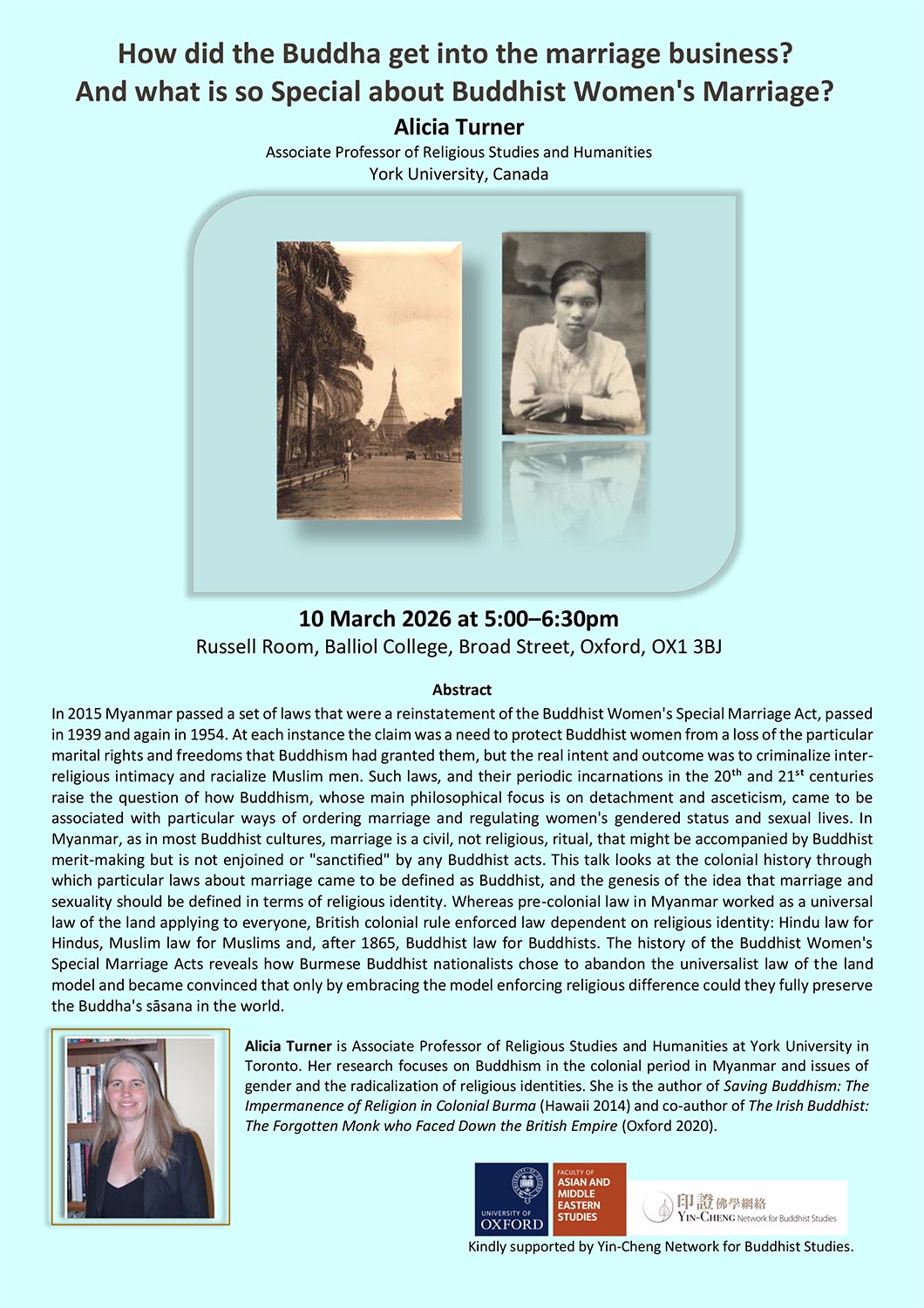

Time: March 10, 5:00 pm – 6:30 pm (Oxford) | March 11, 1:00 am (Beijing/Taipei)
Venue: Russell Room, Balliol College, Broad Street, Oxford, OX1 3BJ
Abstract:
In 2015 Myanmar passed a set of laws that were a reinstatement of the Buddhist Women’s Special Marriage Act, passed in 1939 and again in 1954. At each instance the claim was a need to protect Buddhist women from a loss of the particular marital rights and freedoms that Buddhism had granted them, but the real intent and outcome was to criminalize inter-religious intimacy and racialize Muslim men. Such laws, and their periodic incarnations in the 20ᵗʰ and 21ˢᵗ centuries raise the question of how Buddhism, whose main philosophical focus is on detachment and asceticism, came to be associated with particular ways of ordering marriage and regulating women’s gendered status and sexual lives. In Myanmar, as in most Buddhist cultures, marriage is a civil, not religious, ritual, that might be accompanied by Buddhist merit-making but is not enjoined or “sanctified” by any Buddhist acts. This talk looks at the colonial history through which particular laws about marriage came to be defined as Buddhist, and the genesis of the idea that marriage and sexuality should be defined in terms of religious identity. Whereas pre-colonial law in Myanmar worked as a universal law of the land applying to everyone, British colonial rule enforced law dependent on religious identity: Hindu law for Hindus, Muslim law for Muslims and, after 1865, Buddhist law for Buddhists. The history of the Buddhist Women’s Special Marriage Acts reveals how Burmese Buddhist nationalists chose to abandon the universalist law of the land model and became convinced that only by embracing the model enforcing religious difference could they fully preserve the Buddha’s sāsana in the world.
Speaker: Alicia Turner (York University)
 Alicia Turner is Associate Professor of Religious Studies and Humanities at York University in Toronto. Her research focuses on Buddhism in the colonial period in Myanmar and issues of gender and the radicalization of religious identities. She is the author of Saving Buddhism: The Impermanence of Religion in Colonial Burma (Hawaii 2014) and co-author of The Irish Buddhist: The Forgotten Monk who Faced Down the British Empire (Oxford 2020).
Download the poster