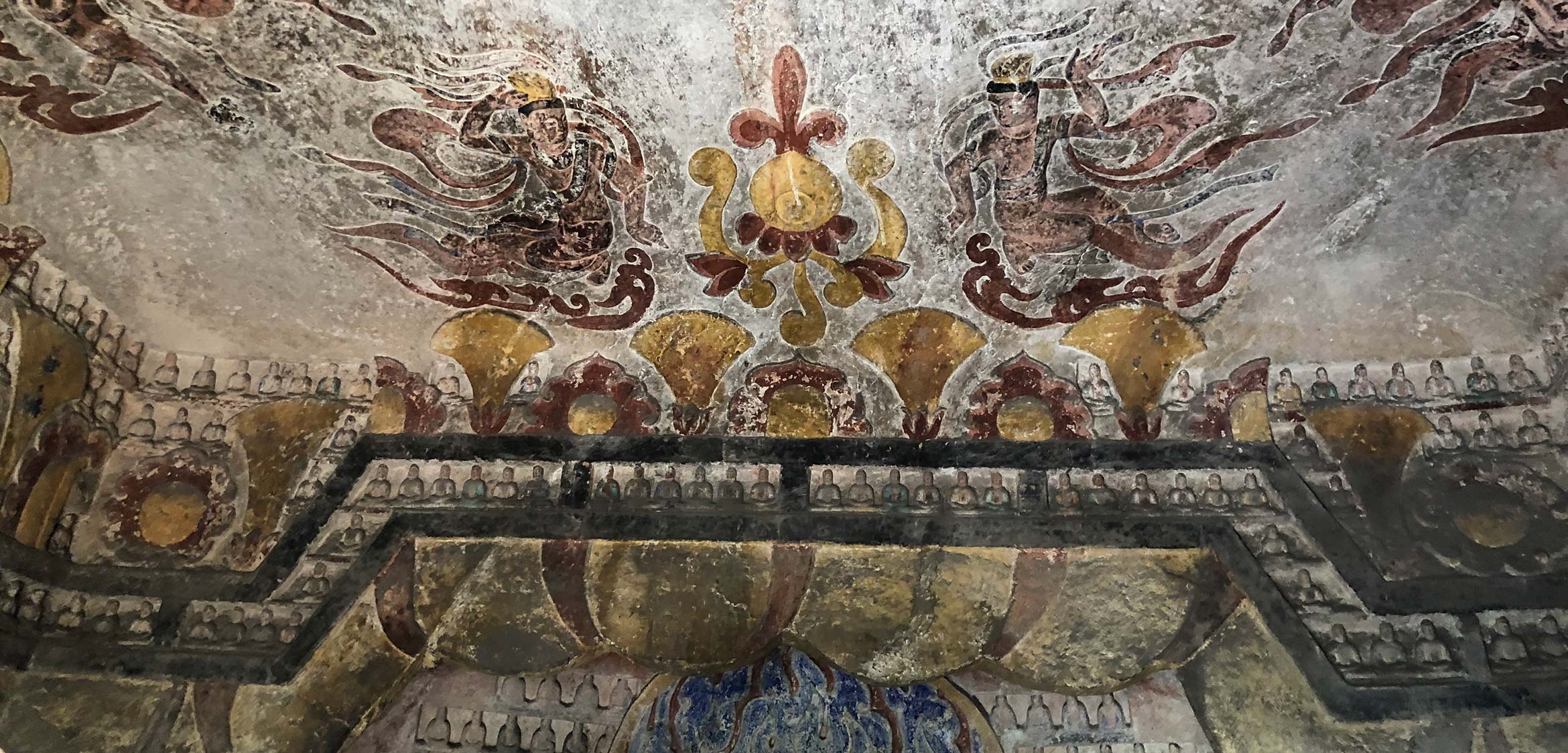
Ceiling of Cave 7 of the Northern Xiangtangshan Grottoes, China. FROGBEAR Cluster 3.2, 2019.
New Sources and Perspectives on Asian Civilizations
亞洲文明研究的新資料與新視野
July 5–6, 2026
(Registration on July 4; departure on July 7)
Venue: Zijin’gang Campus, Zhejiang University, Hangzhou, China
| Abstracts | Panelists | Schedule | Reports |
This symposium is jointly sponsored by the Center for Buddhist Civilization Studies at Zhejiang University (School of History and Institute for Asian Civilizations) and the Glorisun Global Network for Buddhist Studies. It will be held on July 5–6, 2026. Scholars from around the world are warmly invited to submit proposals.
During the formative period of modern European scholarship, the study of Asian civilizations was largely shaped within European intellectual frameworks. Sinology, for example, developed as a branch of Oriental Studies and, alongside disciplines such as Classics, was situated within the broader domain of the Humanities. These institutional and conceptual structures reflected the scholarly priorities of their time and played a foundational role in introducing Asian texts, languages, and histories into modern academic discourse.
Within these early frameworks, the study of Asia was frequently organized through comparative categories in which Europe served as an implicit point of reference. While such approaches generated substantial philological and historical achievements, they often interpreted Asian civilizations through externally derived conceptual lenses.
In the decades surrounding the Second World War, as the geopolitical landscape shifted, the institutional configuration of Asian studies underwent significant transformation. The term “Oriental Studies” gradually fell out of use, and many institutions adopted new designations. In its place, Area Studies emerged as a dominant paradigm. Sinology evolved into “Chinese Studies,” expanding its scope to include a broader range of disciplines—such as sociology, political science, religious studies, and anthropology—well beyond the earlier humanities-based framework. This interdisciplinary expansion further advanced the study of Asia, situating it within new global and institutional contexts.
Today, we find ourselves at another important moment of transition. Rather than viewing this development as a departure from earlier scholarship, it may be understood as part of the continuing global evolution of the field—an opportunity to deepen and refine our understanding of Chinese and Asian civilizations. Increasingly, scholars are calling for approaches more fully grounded in Asian intellectual traditions, historical experiences, and conceptual vocabularies. From the perspective of global history, the contributions of Asian civilizations to human history are vast and multifaceted, yet they have not always been proportionately integrated into broader theoretical narratives. A fuller understanding of Chinese civilization requires renewed engagement with the wider networks of Asian civilizations of which it has long been an integral part.
Such engagement calls for multidisciplinary scholarship that bridges the boundaries among history, religious studies, archaeology, art history, and related fields, fostering cumulative and collaborative forms of knowledge. The aim is not to replace one framework with another, but to cultivate a more dialogical, plural, and globally grounded approach to civilizational history. By encouraging mutually supportive perspectives, we can advance a deeper understanding of the complex interactions among cultures.
In today’s interconnected world, regional dynamics are assuming renewed prominence. New patterns of integration and interaction are reshaping cultural and intellectual landscapes. Just as earlier phases of globalization influenced the formation of academic paradigms, contemporary developments invite fresh reflection on Asia’s historical experiences of connectivity, exchange, and coexistence. The increasing complexity of regional interactions within Asia further underscores the importance of sustained, historically informed scholarship.
To explore the distinctive characteristics and historical trajectories of Asian civilizations, as well as the mechanisms, experiences, and lessons of intercultural exchange, the symposium invites papers on topics including, but not limited to:
- Integrated studies of East Asian civilizations (China, Japan, and Korea)
- The Silk Road and studies of the Western Regions (overland networks)
- The Maritime Silk Road and studies of the East China Sea
- Buddhism and other religions within the broader framework of Asian civilizations
- Buddhism, Silk Road archaeology, and art
- Transregional and cross-cultural interactions among Asian civilizations
- New materials and new perspectives in the study of Asian civilizational history
We encourage the use of newly available sources, innovative methodologies, and collaborative research models to explore emerging areas of inquiry. Interdisciplinary work integrating history, religion, art, archaeology, and related disciplines is especially welcome.
The organizing committee invites scholars engaged in the study of Asian civilizations to contribute. During the conference, accommodation and meals will be covered by the organizers. Subject to available funding, partial travel subsidies may be provided to participants in need.
Selected papers will be published as a special section in the bilingual journal Yazhou wenming shi yanjiu 亞洲文明史研究 [Studies in the History of Asian Civilizations]. Authors will receive a publication honorarium upon submission of the revised final manuscript (no additional payment will be provided beyond this honorarium).
Please submit a research proposal and curriculum vitae by April 15, 2026 to:
30702542@qq.com; FrogBear.Project@ubc.ca.
Scholars who can confidently complete a draft of the paper by mid-June 2026 and submit a final revised version by early October 2026 are warmly encouraged to apply.