

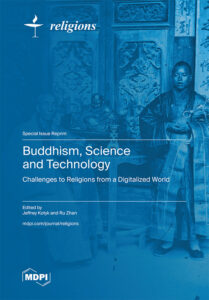
We are pleased to announce the open access release of Buddhism, Science and Technology: Challenges to Religions from a Digitalized World, edited by Jeffrey Kotyk and Ru Zhan, published by MDPI.
Book details:
Jeffrey Kotyk and Ru Zhan, eds. Buddhism, Science and Technology: Challenges to Religions from a Digitalized World. MDPI, February 2025. 191 pages. (This book is a reprint of the Special Issue Buddhism, Science and Technology: Challenges to Religions from a Digitalized World that was published in Religions). ISBN 978-3-7258-3073-2 (Hbk); ISBN 978-3-7258-3074-9 (PDF); https://doi.org/10.3390/books978-3-7258-3074-9
Download book flyer
About the Special Issue:
Buddhism and science represent two drastically different spheres that differ in their goals, the approaches to achieving their respective goals, and their impacts on the world. In its early form, Buddhism sought, above all, liberation from the cycle of existences and the attainment of the ultimate truth. Later in Mahāyāna Buddhism, the goals extended to cultivating compassion and benefiting all sentient beings. In contrast, science develops by inquiring objectively about the world based on empirical evidence, and by advancing technologies. Its central tenets are empiricism and a kind of epistemology firmly rooted in logic. Its goal is to explain the unknown world and to bring material advancement to human societies. It is marked by its “verifiability” and it evolves by constantly verifying hypotheses through trial and error.
In history, however, the relationship between science, technology, and Buddhism has in fact been a symbiotic one. For instance, in Indian Buddhism, Buddhist monastics played not only the role of the “healer” of the mind, but also that of the body. Likewise, in medieval Chinese Buddhism, Buddhist medicine contributed to the treatment of various conditions. Moreover, as Buddhism spread to China, it carried with it the knowledge of Indian mathematics, astrology, calendrical calculation, surgery, and chemistry, all of which expanded the horizon of Chinese science.
Buddhism and science both emphasize observation and empirical verification as the way to derive knowledge. Science achieves this through experimentation, while Buddhists seek truths through meditation and mindfulness. Despite their different approaches, both Buddhism and science aim to solve questions of existential import, with some scientific research even affirming, to a certain extent, Buddhist answers to these questions.
Separation between Buddhism and science is a late modern invention. It came about after the Industrial Revolution, which saw a finer splitting of disciplines and social labors. Science and Buddhism are thereby relegated to two distinct spheres and are sometimes even portrayed as being in opposition. In reality, Buddhism and science have been complementary throughout history in Asia. Even now, Buddhism could still inform science on ethical matters where the latter falls short, especially with regard to the challenges that accompany the trends of globalization and the rapid development of technology. These include the challenges posed by AI for the fate of the humanity, population explosion, and environmental pollution.
About the Special Issue Guest Editors:
Jeffrey Kotyk is a postdoctoral researcher at the Max Planck Institute for the History of Science in Berlin, Germany. His work has dealt with the intersection between Buddhism and astral science in premodern East Asia. He has also worked on various aspects of Asian history. His recent monograph is titled Sino-Iranian and Sino-Arabian Relations in Late Antiquity: China and the Parthians, Sasanians, and Arabs in the First Millennium (Brill, 2024).
Ru Zhan is a professor at Peking University’s School of Foreign Languages. Additionally, he is a member of the Chinese People’s Political Consultative Conference (CPPCC) National Committee, the vice president of the Buddhist Association of China, and the vice president of the Peking University Orientalism Research Institute. His areas of research include Buddhist and Buddhist literature, the Indian Ministry of Buddhism, Dunhuang Buddhism, and Buddhist systems.
Contents:
About the Editors
Preface
Weixing Niu
On Astronomical Materials in Buddhist Scriptures
Reprinted from: Religions 2024, 15, 1321, https://doi.org/10.3390/rel15111321
Douglas S. Duckworth
From Nescience to Science: Buddhist Reflections on Human/Nature
Reprinted from: Religions 2024, 15, 873, https://doi.org/10.3390/rel15070873
Xiang Wei
The Use of Large Language Models for Translating Buddhist Texts from Classical Chinese to Modern English: An Analysis and Evaluation with ChatGPT 4, ERNIE Bot 4, and Gemini Advanced
Reprinted from: Religions 2024, 15, 1559, https://doi.org/10.3390/rel15121559
Elena Ostrovskaya and Timur Badmatsyrenov
Monks, Blogs and Three Media Cases: Russian-Speaking Buddhist Communities in the Era of Social Media
Reprinted from: Religions 2024, 15, 1186, https://doi.org/10.3390/rel15101186
Brianna K. Morseth
Bridging Ecologies through Contemplative Technologies: Existential Relevance of Huatou 話頭 and the Huayan sanmei men 華嚴三昧門 for Oxytocin and Environmentally Sustainable Behavior
Reprinted from: Religions 2024, 15, 1164, https://doi.org/10.3390/rel15101164
Wei Li and Yingjin Chen
Permutations and Oblong Numbers in the Theravada-vinaya: A New Intersection of Buddhism and Indian Mathematics
Reprinted from: Religions 2024, 15, 1156, https://doi.org/10.3390/rel15101156
Liqun Zhou
From Modengjia Jing to Xiuyaojing: The Accumulation of Indian Astronomical Knowledge in the ChineseBuddhist Canon
Reprinted from: Religions 2024, 15, 968, https://doi.org/10.3390/rel15080968
Qijun Zheng
Divine Medicine: Healing and Charity Through Spirit-Writing in China
Reprinted from: Religions 2024, 15, 1303, https://doi.org/10.3390/rel15111303
Saiping An
The Apologetic Discourse towards the Convergence between Pure Land Buddhism and Theoretical Physics of the Contemporary Chinese Buddhist Monk, Da An (1959- )
Reprinted from: Religions 2024, 15, 810, https://doi.org/10.3390/rel15070810
Qi Liu
Adaptation to Third-Party Payments: Statistical Analysis of Digital Donations Made to Donglin Monastery
Reprinted from: Religions 2024, 15, 797, https://doi.org/10.3390/rel15070797