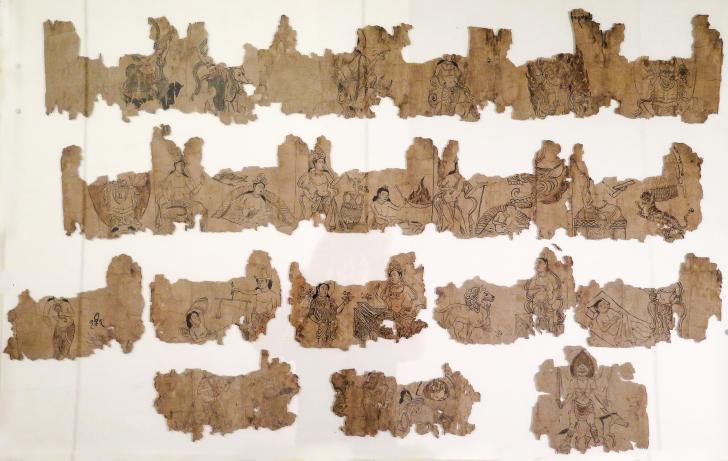
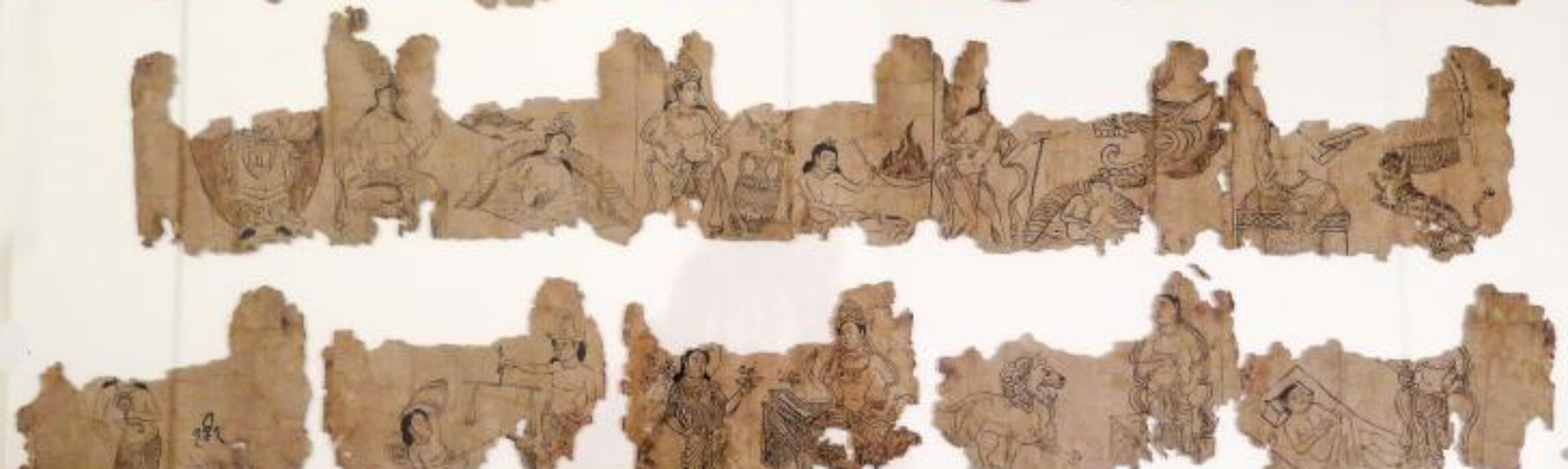
Astrological scroll, ca. 8th–10th c., probably Turfan Region, Xinjiang, China, ink and colors on paper, h. 19.1 cm (max.), w. in scroll format ca. 324.5 cm in total. Museum für Asiatische Kunst, Berlin, III 520 Photo © Museum für Asiatische Kunst, Staatliche Museen zu Berlin/Birgit A. Schmidt.
Project (2026-2028)
Findings, Formats, and Functions: Reinvestigating a Unique Astrological Scroll from the Turfan Collection in Berlin (III 520)
Dept. AAK
Source-Based Initiatives
Heavens in Your Hand: Artifacts and Astral Practices in Eurasia and North Africa (4000 BCE–1700 CE)
Jeffrey Kotyk Aida Alavi Dagmar Schäfer
Other Scholars Involved: Lilla Russell-Smith
Brought to Berlin by the German Turfan Expeditions between 1902 and 1914, the unique scroll III 520 today forms part of the Turfan Collection. Although its precise findspot remains unknown, it was likely discovered in the Turfan region (today’s Xinjiang Autonomous Region, China) and dates to the eighth or ninth century. In the area’s extremely dry desert climate—hot in summer and cold in winter—paper manuscripts have survived in more than twenty languages and scripts, though the vast majority are highly fragmented. Preserved today in four sections, this scroll can be reconstructed to an approximate original length of around 320 cm, making it one of the most significant manuscripts in the collection.
One side displays a series of deities and scenes executed in ink and light color washes. A text in Brahmi and the Tocharian B language originally ran along the top of the entire scroll, with further inscriptions in these scripts and in Sanskrit visible in several scenes. The reverse bears a Chinese text.
During its 1982 exhibition at the Metropolitan Museum of Art in New York, the Chinese text on the non-figural side was identified as the Anthology of Literature (Ch. Wenxuan 文選), a renowned sixth-century compilation. In 1997, Tsuneki Nishiwaki reconstructed the Chinese text and demonstrated that the scroll consists of two separate layers of paper. A Chinese scroll had been cut down in height and its sections repasted to serve as backing for the figural side, indicating that the illustrations must postdate the Chinese text. Crucially, the original order of the Chinese text was maintained, which secures the sequence of the figures on the other side.
Also in 1997, Frantz Grenet and Jean-Jacques Pinault published a detailed analysis of the figural side. They were the first to link the scenes to the zodiac signs and identified certain additional details as depictions of the decans through comparison with a thirteenth-century European codex and an early Islamicate astral text by Abū Maʿšar from Balkh (originally written in Arabic, this text was translated into Latin and became widely circulated in Europe as an illustrated handbook, with multiple versions extant).
After nearly thirty years, the time has come to revisit this remarkable object and its fascinating transcultural background. The illustrations on the scroll are unique, with many details still unexplained. By situating III 520 within the existing scholarship and a broader historical context, this interdisciplinary project will uncover new insights into the transmission of astral imagery in Eastern Central Asia.
Our focus will be on the “three Fs”:
Findings: By comparing the known literature to date with more recent research on related topics, this transdisciplinary project will investigate further possible astral meanings and features of the illustrations.
Formats: III 520 will be examined for its materiality and format within the book cultures of the European, Asian, and Islamicate worlds. The research will include small team discussions and a series of workshops. It is planned to raise funds for additional scientific study of the materiality and inks, as well as for the restoration of the manuscript to ensure its long-term conservation.
Functions: The original function of the scroll will be explored. Understanding how it was used may shed light on the distinctive composition of the scenes.
The results of this project will be presented in a studio display in the permanent exhibition of the Museum für Asiatische Kunst at the Humboldt Forum in Berlin. Publications aimed at both specialists and the general public are also planned.

Astrological scroll, ca. 8th–10th c., probably Turfan Region, Xinjiang, China, ink and colors on paper, h. 19.1 cm (max.), w. in scroll format ca. 324.5 cm in total. Museum für Asiatische Kunst, Berlin, III 520 Photo © Museum für Asiatische Kunst, Staatliche Museen zu Berlin/Birgit A. Schmidt.